

Running Out of Space on Your Food Packaging? Try Extended Content Labels
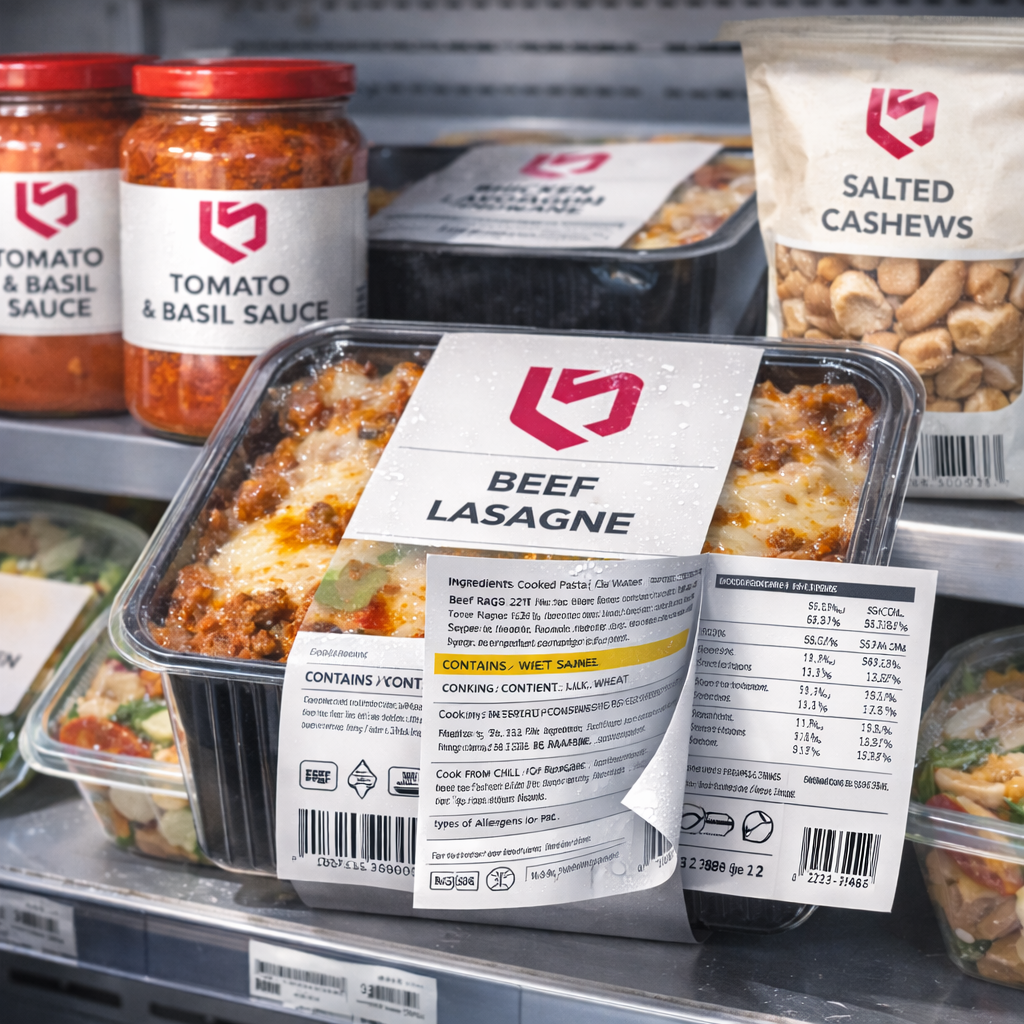
Food packaging has not grown, but food labelling requirements have. Ingredient transparency, allergen emphasis, nutritional declarations and recycling instructions now compete for limited space on increasingly compact packs. For many brands, the issue is no longer graphic design. It is structural capacity.
When mandatory information exceeds available print area, extended content labels provide a compliant and commercially efficient solution.
Why Food Labels Are Under Pressure
UK food labelling rules require clear disclosure of the legal name of the food, a full ingredient list in descending order by weight, emphasised allergens, nutritional information per 100g or 100ml, storage conditions, date marking and the details of the food business operator. Where applicable, origin declarations and quantitative ingredient statements must also appear.
For simple products, this may remain manageable. For ready meals, supplements, sauces, imported goods or health-positioned foods, content density increases quickly. Voluntary claims such as “high protein” or sustainability messaging add further layers of text.
Reducing font size to fit more content introduces risk. Legibility is a regulatory requirement. If consumers struggle to read allergen information, the consequences can extend beyond enforcement into safety and liability concerns.
Multi-Market Distribution and Language Duplication
Export ambitions increase complexity. Supplying both Great Britain and Northern Ireland may require careful alignment with different regulatory frameworks. Selling into additional EU territories multiplies language requirements.
Duplicating full ingredient and nutritional panels in two or three languages can overwhelm small jars, bottles and pouches. Maintaining separate packaging variants for each market increases cost and complicates stock management.
Extended content labels allow brands to consolidate information into a layered construction. Additional panels are accessed by lifting the top layer, expanding usable print area without altering pack size.
Preserving Clarity and Brand Integrity
Overcrowded labels undermine both compliance and brand perception. Dense, cluttered layouts reduce shelf impact and diminish premium positioning. Extended content labels separate branding from regulatory text. The outer panel can carry essential product identity and key information, while inner panels present detailed content in a structured and readable format.
This separation improves clarity for enforcement authorities and consumers alike.
Extended content formats also provide flexibility. If allergen declarations change or a reformulation requires updates, revisions can often be accommodated within the layered structure without a complete packaging redesign.
When Extended Content Labels Make Commercial Sense
Extended content labels are particularly effective when packaging surface area is limited, when ingredient lists exceed one panel or when multiple language versions are required. They are widely used on compact food formats where space is structurally constrained but regulatory content continues to expand.
They also support products with complex preparation instructions or detailed sustainability disclosures.
A Practical Compliance Strategy for 2026
Food labelling obligations are unlikely to decrease. Transparency expectations remain high, enforcement activity continues and environmental messaging is under increasing scrutiny. Brands that attempt to compress growing information onto static single-layer labels risk readability failures and frequent redesign cycles.
Extended content labels provide structural scalability. They increase available space, preserve legibility and protect brand presentation without altering container dimensions.