

Best Practices for Allergen Labelling on Prepacked Direct Sales Foods Under Natasha’s Law
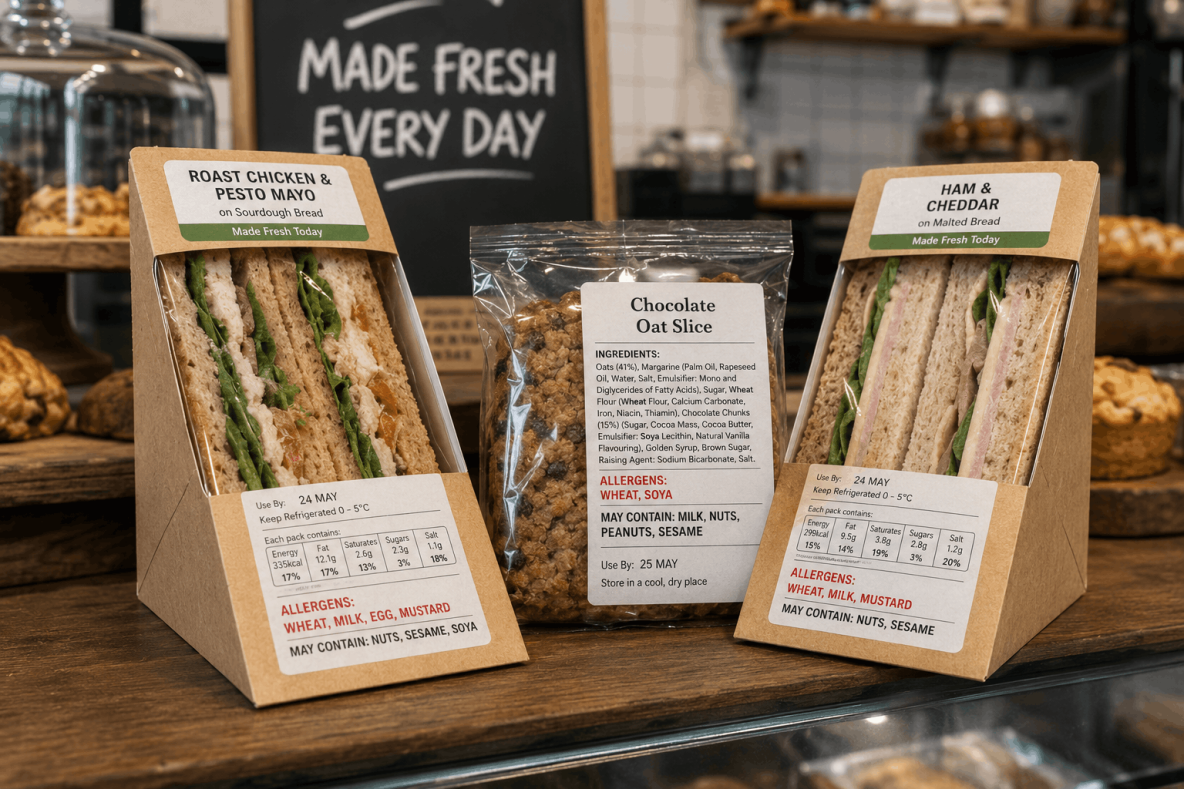
Natasha’s Law has been in force since 1 October 2021. Despite four years of regulatory operation, a regional Trading Standards survey found 56 out of 100 food businesses were not providing fully compliant ingredient lists for prepacked direct sale food. Enforcement activity has increased in 2025 and 2026, with local authorities prioritising PPDS inspections as part of broader food allergen safety programmes.
For any food business preparing and packaging food on-site for sale to consumers, such as bakeries, cafés, sandwich counters, food stalls, school canteens, and deli operations, the compliance obligations under Natasha’s Law are active now, and the consequences of non-compliance range from enforcement notices to prosecution.
Natasha’s Law requires that every food item prepacked for direct sale carries two things on its label: the name of the food, and a complete list of ingredients with the 14 major allergens emphasised within it.
Emphasis means a typographic distinction (most commonly bold text) that makes each allergen visually distinct from the surrounding ingredient list. The emphasis applies to the allergen itself and to any derivative of it. Sesame must be emphasised if sesame paste or tahini is listed. Milk must be emphasised if skimmed milk powder or whey protein is present.
What Must Appear on a PPDS Label
The name of the food must be specific enough that a consumer understands what the product is. “Sandwich” is insufficient; “Chicken and Bacon Sandwich” meets the standard. The ingredients list must run in descending order of weight at the time of manufacture. Water added during production must be listed.
Compound ingredients must be listed with their sub-ingredients in brackets. Every ingredient must be declared, with no exceptions for trace quantities. The 14 declarable allergens are: cereals containing gluten, crustaceans, eggs, fish, peanuts, soybeans, milk, nuts, celery, mustard, sesame, sulphur dioxide and sulphites, lupin, and molluscs.
Precautionary allergen statements (“may contain” warnings) are not mandatory under Natasha’s Law but are permitted where a genuine cross-contamination risk exists following a written allergen risk assessment.
The FSA guidance is explicit that blanket application of “may contain” warnings without an evidence-based risk assessment is discouraged. Where a precautionary statement is warranted, it should appear separately from the ingredients list, clearly identifying the specific allergen and the nature of the contamination risk.
Label Design That Supports Compliance
The physical label must be indelible and legible. For PPDS products with limited packaging surface area (individual portions, small bakery items, snack formats) the information requirement is the same regardless of pack size.
Where a compliant ingredient list with emphasised allergens cannot fit on the primary label at a readable size, extended label formats including peel and reveal constructions provide additional panel space without changing the pack format.
Recipe changes that introduce a new ingredient — particularly a new allergen — require label update before the product goes on sale, not after the next scheduled label run. Systems for managing recipe changes and their label consequences reduce the risk of allergen incidents and the enforcement exposure that follows them.