

Food Labels Are Running Out Of Space For Allergens
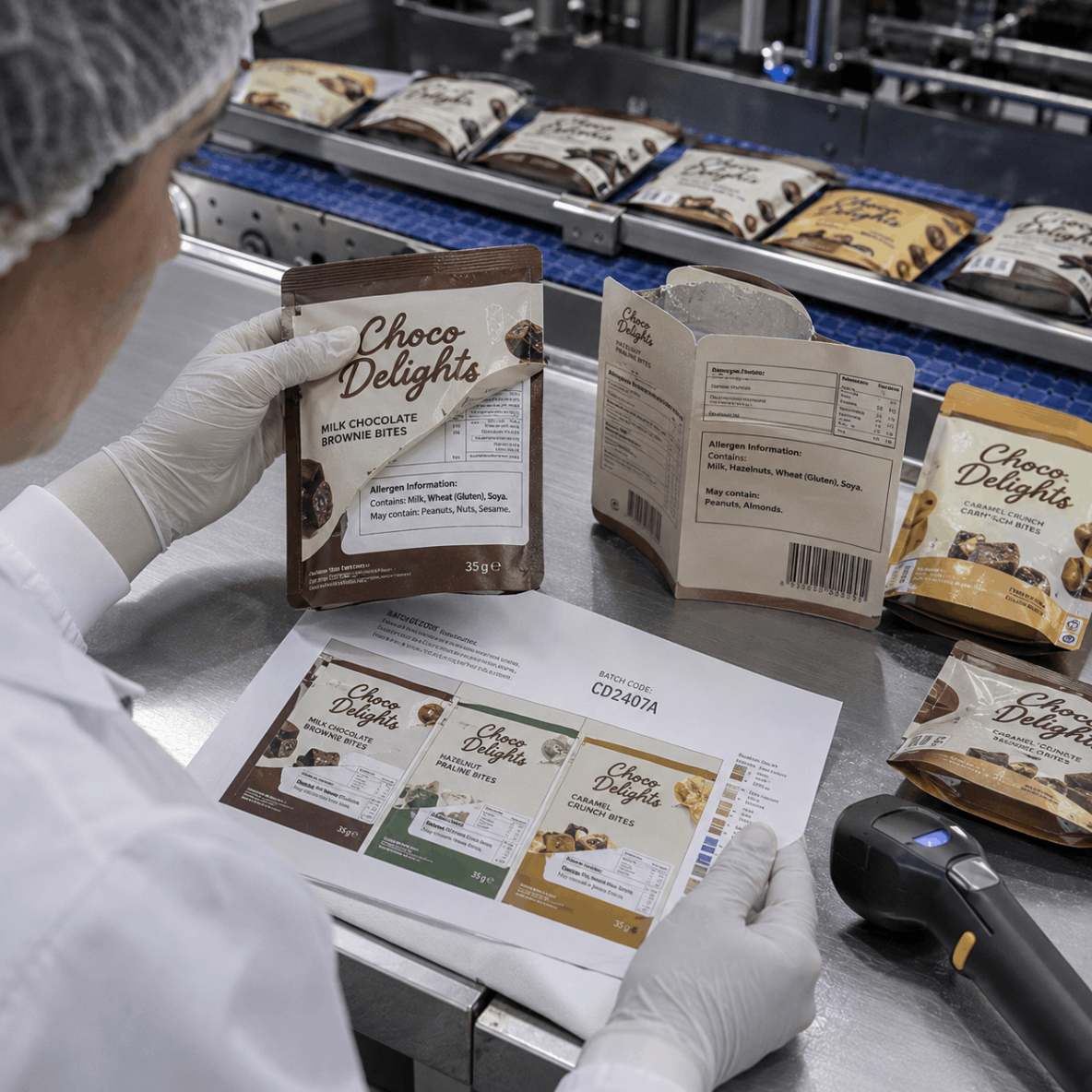
Allergen declarations keep growing longer, but pack sizes have not grown to match them. UK food businesses issued 141 product recalls in 2025, a 23% rise on the year before, with undeclared allergens remaining the single biggest cause, and much of that gap traces back to labels that simply do not have room for everything an ingredient list now needs to say.
This article looks at why space, not just wording, has become the real allergen labelling problem, and what formats actually solve it.
Why Space Is the Real Constraint
Full ingredient labelling under Natasha’s Law, alongside allergen emphasis requirements and growing ingredient lists as recipes diversify, has pushed most standard flat labels close to their limit. A label that legally complies with every allergen requirement can still fail in practice if the type is shrunk so small that a genuinely allergic customer cannot read it quickly on a busy shelf, which is a real risk on smaller snack and confectionery formats where near identical flavour variants often run on the same production line within minutes of each other.
What Actually Solves the Space Problem
Booklet and peel and reveal formats give a pack several times the printable area of a flat label without changing its footprint, which is exactly the extra room allergen information needs. That additional space allows a full, clearly legible allergen statement without forcing everything else on pack to shrink to accommodate it. For producers running multiple close variants through the same line, a format that can also carry clearer batch coding adds a second layer of protection, since a mispack caught and correctly coded is a far smaller recall than one that reaches shelves undetected. Colour or shape differentiated packaging between near identical flavour variants offers a further, low cost safeguard for exactly the same reason.
141 Recalls in 2025 Trace Back to a Space Problem
Discussion among food safety and packaging teams has increasingly connected this year’s recall figures directly to label space rather than treating allergen compliance purely as a wording exercise. There is growing recognition that a label technically meeting every legal requirement can still contribute to a mispack risk if the format itself was never designed to carry the volume of information modern allergen rules require.
A label that technically complies but cannot be read quickly is not a compliant label in any way that matters to an allergic customer standing in front of a shelf. Producers auditing format alongside content now are the ones closing the gap between what the law requires and what actually keeps someone safe.