

What the HFSS Watershed Ban Means for the Information on Your Food Labels
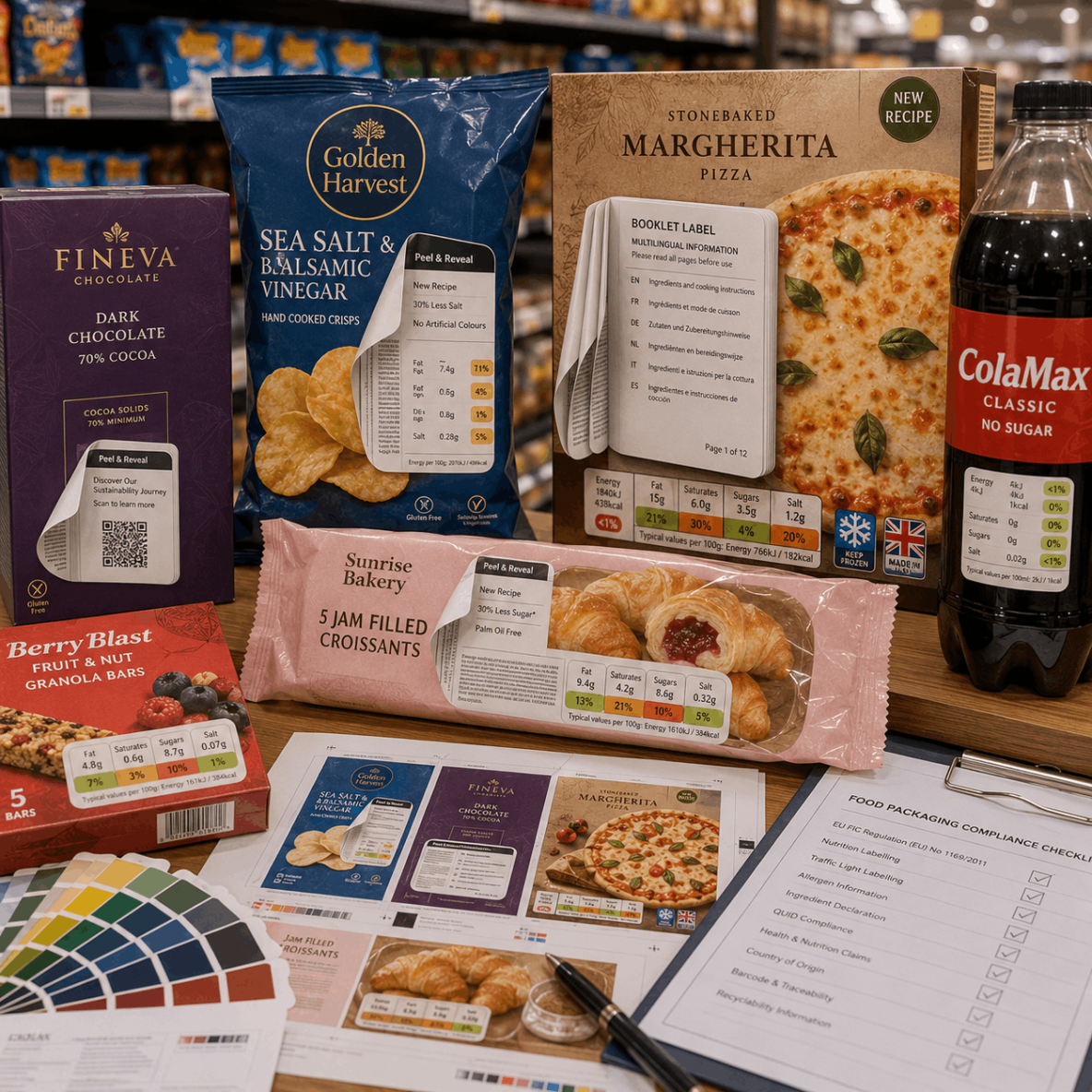
Since 5 January 2026, paid online advertising for identifiable food and drink products classified as high in fat, salt, or sugar has been prohibited at all times. Television advertising for the same products is banned before the 9pm watershed. The restrictions apply across 13 product categories including confectionery, soft drinks, crisps, morning goods, pizza, ready meals, and ice cream, with classifications determined by the government’s Nutrient Profiling Model. For food brands operating in those categories, the advertising landscape has fundamentally changed. And with it, what the food label needs to do has changed too.
The Label Is Now the Primary Touchpoint
When a brand can no longer run paid online ads showing its product, and cannot show it on television before 9pm, the moment a consumer encounters the physical product, whether on shelf, in a delivery box, or at a convenience counter, becomes the primary and often only unrestricted marketing touchpoint. The label that was previously one element in a broader campaign is now doing the work the campaign used to do.
This is not a theoretical shift. The ASA has already upheld complaints against supermarkets for paid digital advertisements featuring identifiable HFSS products, confirming that even a single in-scope product appearing in an ad constitutes a breach. Brands are adapting their paid media to focus on brand values without showing specific products. The physical pack, by contrast, faces no such restriction. Whatever the brand wants the consumer to know, including reformulation stories, nutritional improvements, or health positioning, has to live on the label.
What That Means for Label Content and Space
The practical consequence for food label design is a shift in information hierarchy and content load. Messaging that previously lived in advertising, such as “now with less sugar” or the story behind a reformulation, now needs to appear on-pack. The front of pack is already carrying mandatory energy value declarations in the Nutrition Labelling colour coding format, best-before information, allergen highlights, net weight, and brand design. Adding substantive health or reformulation messaging into that space without compromising legibility or violating any of those mandatory elements is a real design challenge.
Extended content label formats offer a route through it. A booklet or peel and reveal label allows the front face to carry the brand presentation and mandatory declarations clearly, while the additional panel space carries the reformulation narrative, extended nutritional information, or health-positioning content that the brand can no longer communicate through paid media. For products in the HFSS categories that have reformulated, or that are reformulating to move below the Nutrient Profiling Model threshold and restore advertising eligibility, the label is where that story needs to be told first.
The NPM Consultation Adds Further Uncertainty
In March 2026, the government launched a consultation on applying a revised Nutrient Profiling Model to the advertising restrictions, with responses due by 17 June 2026. Products currently outside HFSS classification could fall within it if the model is updated. Brands that have reformulated to just below the current threshold face the prospect of repeating that exercise if the NPM boundary moves. A label format that can accommodate updated nutritional claims and messaging efficiently is a structural advantage when reformulation cycles accelerate.